
Thanksgiving Side Dishes: The Stories Behind the Traditions
Ask someone what they are cooking for Thanksgiving, and the first answer is usually turkey.
But think about what happens when everyone sits down at the table.
Someone reaches for the mashed potatoes.
Someone else wants the stuffing.
The green bean casserole gets passed around.
There’s cranberry sauce, sweet potatoes, roasted vegetables, and perhaps a family recipe that has appeared every Thanksgiving for generations.
And suddenly, the side dishes are getting just as much attention as the main course.
But have you ever wondered where these Thanksgiving traditions came from?
Some have roots in Indigenous American agriculture. Others arrived through European cooking traditions. A few are surprisingly modern inventions.
Together, they tell a fascinating story about how American Thanksgiving meals developed over time.
The First Thanksgiving Didn’t Look Like Today’s Dinner
When people imagine the 1621 harvest gathering involving the Plymouth colonists and the Wampanoag people, they often picture a modern Thanksgiving table.
Turkey.
Mashed potatoes.
Stuffing.
Cranberry sauce.
Pumpkin pie.
But the historical record doesn’t support that familiar menu.
The gathering took place in a very different world, with foods shaped by the region, the season, and the knowledge of the Wampanoag people, who had lived there long before the English colonists arrived.
Historical accounts mention venison and wildfowl, while local foods likely included corn and other available ingredients.
We don’t have a complete menu.
And many dishes associated with Thanksgiving today developed much later.
The Thanksgiving table we recognize is the result of centuries of changing food traditions.
Mashed Potatoes: A Tradition That Arrived Later
It’s difficult to imagine Thanksgiving without mashed potatoes.
Yet potatoes weren’t part of the traditional agriculture of the Wampanoag people in seventeenth-century New England.
Potatoes originated in the Andes of South America, where Indigenous communities cultivated them for thousands of years.
After Europeans encountered potatoes in the Americas, the crop gradually spread to Europe and eventually became an important part of North American cooking.
Mashed potatoes developed into a familiar comfort food, especially when combined with butter, milk, or cream.
Their smooth texture and mild flavor made them a natural partner for holiday meals.
Today, mashed potatoes may seem inseparable from Thanksgiving.
But their place on the table reflects a much longer journey through agricultural and culinary history.
Sweet Potatoes: From American Roots to Holiday Casseroles
Sweet potatoes have a different history.
They originated in tropical America and were cultivated long before European colonization.
Over time, sweet potatoes became especially important in Southern American cooking.
They could be roasted, baked, mashed, or prepared in sweet and savory dishes.
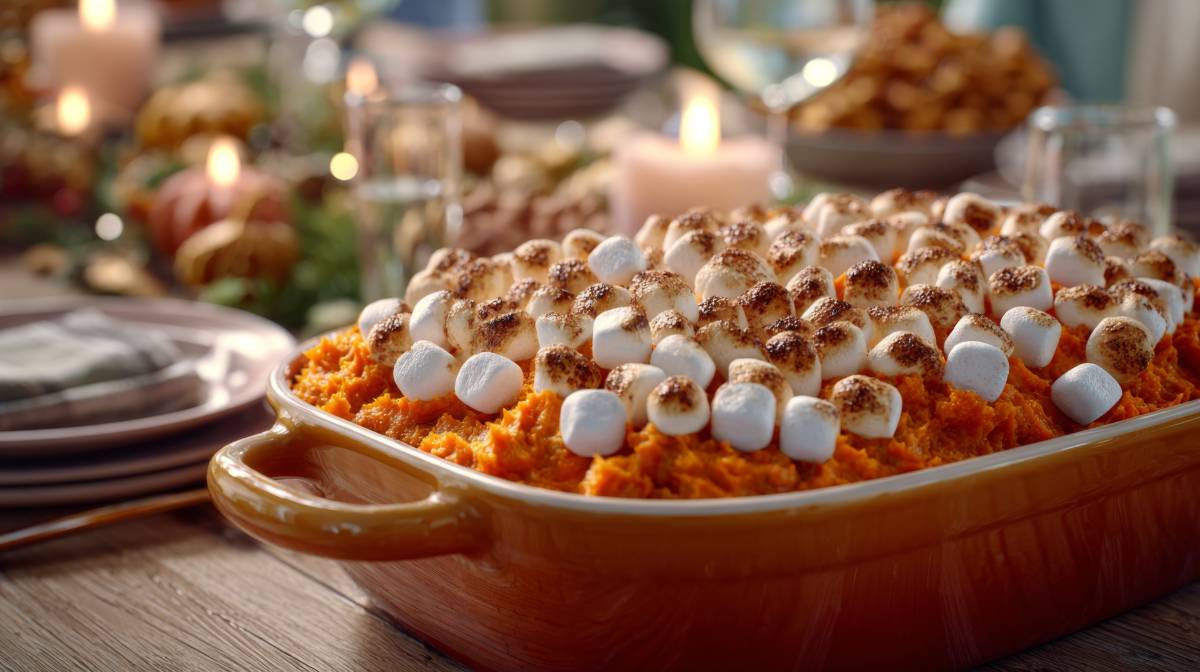
But what about the famous sweet potato casserole topped with marshmallows?
That tradition is much newer.
In the early twentieth century, marshmallow manufacturers promoted recipes combining sweet potatoes with marshmallows.
The idea eventually became a familiar Thanksgiving preparation.
It’s a perfect example of how food traditions can develop.
An ancient crop becomes a regional favorite.
Then a modern commercial recipe helps create a holiday classic.
Green Bean Casserole: A Thanksgiving Tradition Born in 1955
Here’s one of the most surprising Thanksgiving stories.
Green bean casserole isn’t an ancient family recipe passed down from colonial times.
It was created in 1955 by Dorcas Reilly, who worked in the test kitchen of Campbell’s.
The original recipe combined green beans, condensed cream of mushroom soup, and crispy fried onions.
The goal was convenience.
Ingredients were inexpensive, widely available, and easy to combine.
The dish became enormously popular and eventually found a permanent place on many Thanksgiving tables.
Today, some families prepare the classic version while others make homemade mushroom sauces or use fresh green beans.
Either way, a recipe developed in a corporate test kitchen became a national holiday tradition.
Not every traditional dish needs centuries of history.
Sometimes a few generations are enough.
Stuffing: A Much Older Cooking Idea
Stuffing has a history that extends far beyond Thanksgiving.
People have been filling foods with bread, grains, herbs, vegetables, and other ingredients since ancient times.
Different cultures developed their own versions.
Some used bread.
Others used rice or grains.
Many incorporated onions, herbs, nuts, dried fruits, or vegetables.
In American Thanksgiving cooking, bread-based stuffing became especially familiar.
But stuffing doesn’t have to be cooked inside a bird.
When prepared separately in a baking dish, it’s often called dressing, although regional naming traditions vary.
For a vegetable-focused Thanksgiving table, stuffing can become one of the most interesting dishes.
Mushrooms, onions, celery, herbs, and roasted vegetables can turn simple bread into something wonderful.
Cranberry Sauce: A Native Fruit with a Changing History
Cranberries are native to North America.
Indigenous peoples used cranberries in food and other applications long before European colonization.
The fruit’s tart flavor made it useful in different preparations, and cranberries eventually became closely associated with Thanksgiving.
But the familiar sweet cranberry sauce developed through changing cooking practices and the increasing availability of sugar.
Today, cranberry sauce appears in several forms.
Some families prepare it fresh with whole berries.
Others prefer a smooth sauce.
And some wouldn’t consider Thanksgiving complete without the familiar canned version.
It’s interesting how one small fruit can inspire such strong family preferences.
Cornbread: A Connection to Indigenous Agriculture
Corn has one of the most important histories of any food on the American continent.
Indigenous peoples domesticated maize in what is now Mexico thousands of years ago, and cultivation spread across the Americas.
By the time Europeans arrived in North America, corn was already central to many Indigenous food systems.
Different communities developed sophisticated ways to grow, process, and prepare it.
European settlers later adopted cornmeal into their own cooking traditions.
Over time, cornbread became particularly associated with Southern American cuisine.
Today, cornbread may appear at Thanksgiving as a side dish or as the foundation for cornbread dressing.
Its presence reminds us that American food traditions developed through encounters among different cultures, although those encounters also involved displacement, exploitation, and profound losses for Indigenous communities.
Roasted Vegetables: Perhaps the Simplest Tradition
Not every Thanksgiving side dish has a famous inventor or a specific date.
Roasting vegetables is a cooking method with a very long history.
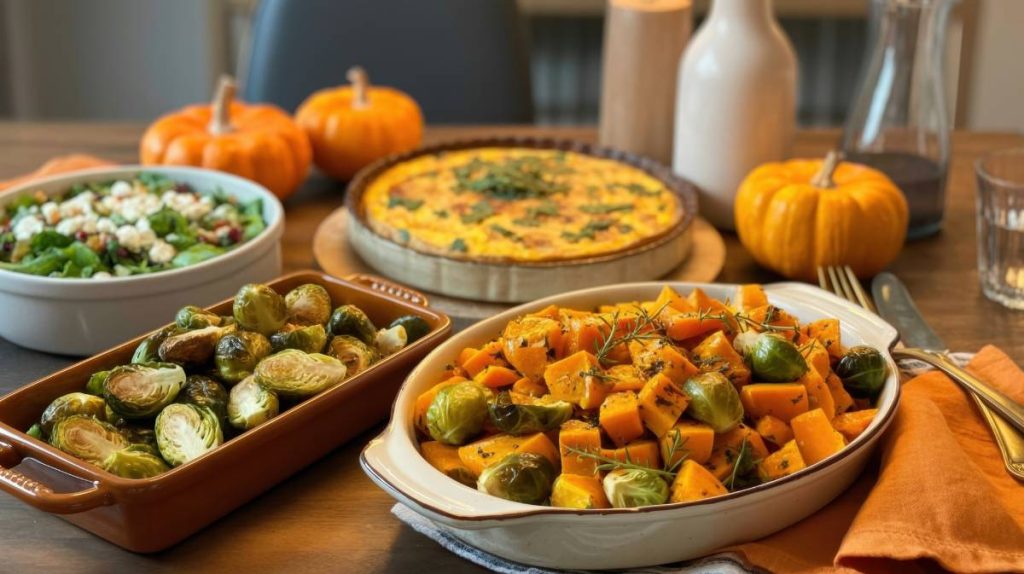
Carrots, onions, squash, turnips, parsnips, and other seasonal vegetables can become flavorful with little more than heat, oil, and seasoning.
The vegetables available have changed over time and from one region to another.
But the principle remains familiar.
Take what the season provides.
Prepare it simply.
Cook it until tender and flavorful.
For Let’s Veg, roasted vegetables represent something important.
They don’t need to imitate the main course.
They deserve their own place at the table.
Pumpkin: From Indigenous Food to Holiday Tradition
Pumpkins and other squash were cultivated in the Americas long before European settlement.
Indigenous communities grew different varieties and used them in numerous preparations.
European settlers gradually incorporated squash into their own cooking.
Over time, pumpkin became associated with autumn harvest celebrations.
The familiar sweet pumpkin pie developed through changing recipes, ingredients, and baking traditions.
Although pumpkin pie is technically dessert rather than a side dish, its history belongs in the larger Thanksgiving story.
It shows how an ingredient with deep agricultural roots in the Americas became part of a modern holiday tradition.
Why Thanksgiving Side Dishes Became So Important
There’s something interesting about Thanksgiving.
The main course may be the centerpiece, but the side dishes often carry the strongest family memories.
One person remembers their grandmother’s stuffing.
Another insists that sweet potatoes must be prepared a particular way.
Someone has been making the same cranberry sauce for thirty years.
And someone always brings the green bean casserole.
These dishes become part of family identity.
Recipes are passed down, adjusted, argued over, and eventually passed to another generation.
The ingredients may be ordinary.
But the memories surrounding them are anything but
A Thanksgiving Table Without Turkey?
Here’s a question worth asking.
What happens if you remove the turkey from Thanksgiving dinner?
You may still have mashed potatoes, roasted vegetables, sweet potatoes, stuffing, cranberry sauce, green beans, squash, bread, and countless other dishes.
That’s practically an entire feast.
Of course, some traditional preparations contain meat-based broth or other animal ingredients, but many can be made vegetarian with simple adjustments.
Thanksgiving already offers an extraordinary variety of vegetable-centered foods.
We just don’t always recognize them as the stars of the meal.
Perhaps it’s time we did.
The Let’s Veg Way
At Let’s Veg, we believe vegetables deserve more attention, especially during celebrations.
Thanksgiving is a wonderful example.
People spend hours planning the main course, yet the side dishes are often what make the meal feel complete.
A tray of roasted carrots.
A bowl of mashed potatoes.
A flavorful mushroom stuffing.
Sweet potatoes.
Green beans.
A colorful vegetable casserole.
These aren’t simply extras.
They’re part of the tradition, the flavor, and the memories.
And you don’t need complicated cooking techniques to make them special.
Fresh ingredients, thoughtful seasoning, and a little care can create dishes everyone wants to share.
Thanksgiving side dishes tell a much bigger story than we might expect.
They connect ancient Indigenous agriculture with European cooking traditions.
They show how regional foods became national favorites.
They reveal how modern food companies helped create new traditions.
And they remind us that holiday meals continue evolving.
Some dishes have histories stretching back thousands of years.
Others are barely older than our grandparents.
Yet all of them can become meaningful when families gather around the table.
So this Thanksgiving, while everyone is talking about the turkey, take another look at the vegetables, potatoes, stuffing, and other dishes surrounding it.
They have stories worth telling too.
And sometimes, the most memorable part of the meal isn’t the centerpiece.
It’s everything that brings the table together.
Cook Simple • Eat Together
Start with the Vegetable Cooking Guide:
https://www.letsveg.com/vegetable-cooking-guide